Asian Chicken and Noodle Soup

This is a blend of Japanese and Chinese ingredients.  We love good Udon noodles (Japanese), Ramen eggs (Japanese) instead of regular eggs.  We use Napa cabbage (Chinese) but baby bok choy is also good.  The Japanese ramen broth is a Dashi which consists of boiled seaweed and dried Bonita fish flakes; and that is good, but a Chinese chicken flavor with a hint of cumin is a little better.  We also like to use Chinese Shaoxing wine instead of Japanese Sake.  Japanese broths can be sweeter when using Mirin.  Chinese doesn’t use sugar or Mirin.  As far a soy sauce is concerned a 50/50 split of regular soy and Japanese Tamari is a good combination.  We also like to add Shitake mushroom as it does add flavor.  One flavor that is neither Japanese or Chinese is a Galangal root that is Thai, Vietnamese, Indonesian used as a substitute for ginger. 

Ramon egg:  The night before boil the egg and peel. In a plastic container add 3 TBSP soy sauce with 3 TBSP sugar and 2 cups water and mix. Drop the peeled egg into the mixture so that it is submerged and leave in the frig overnight to marinate.

Broth:
1 TBSP veg oil
2 chicken thighs with skin and bone
3 garlic cloves, smashed
1” galanga (or ginger)
1 green onion, cut into 2 pieces (separate the green from the white part)
½ tsp cumin seeds
½ tsp peppercorns
1 teaspoon Shaoxing wine
½ tsp soy sauce
½ tsp Tamari soy sauce
4 cups chicken broth
½ bunch of fresh cilantro
1 bay leaf
Shitake mushrooms (rehydrated or fresh)
1 Whole medium carrot, peeled
4 Napa Cabbage leaves
2 packs of fresh jumbo udon noodles Japanese style (1 pack for each bowl)

Add oil in a large pot and add everything but the chicken broth, mushrooms, cilantro and wine, lightly brown everything turning over the chicken thighs and stirring until the chicken browns a little and the other seasonings begin to create an aroma (~2 minutes).  Then add the broth, wine, mushrooms, cilantro, soy sauce and bring to a medium boil reduce to simmer and cook 20 minutes. 

Remove the chicken a shred or cut into piece.  Remove the carrot and cut into matchsticks.  Remove the shitake mushrooms and thinly slice.  Strain the chicken broth and discard everything else.

Return the broth to the pot and heat until hot.  Add the Napa Cabbage leaves until cooked a little. 

Boil the udon noodles in separate water (no salt).  Plate the noodles, then all the other ingredients and then pour over the hot broth and serve while hot.

Makes 2 large bowls

2/9/22

Tuna Noodle Casserole

2 cups dry egg noodles
3 TBSP butter
1/2 yellow onion, chopped
1 cup of chopped white mushrooms
3 TBSP flour
2 cups cold milk
½ cup dry white wine
1 (10-oz) can condensed, cream of mushroom soup
salt and freshly ground black pepper
3 (5-oz) cans tuna, well drained, chuck albacore
1 TBSP old bay
3/4 cup frozen peas, thawed, drained
1 cup shredded sharp cheddar cheese
1/2 cup shredded Monterey jack cheese
1/2 cup plain panko
4 tbsp butter for panko

In a medium saucepan melt 3 TBSP butter and sauté the onions and mushroom over med-low heat for about 4 minutes. Turn up the heat to medium; add the flour, and cook, stirring, for another 2 minutes. While whisking vigorously, slowly pour in one cup of the cold milk.  The mixture should begin to look like a gravy. 

When the mixture begins to simmer, add the wine and the rest of the milk, can of mushroom soup, salt, and pepper and cheese. Cook, stirring occasionally, until the sauce thickens, and comes to a simmer. Remove from heat, and reserve.

Cook noodles in boiling salted water 10 minutes. Drain and add to a large mixing bowl. Add the sauce, tuna, peas, salt, pepper, and Old Bay.  Mix with a spatula to combine. 

Preheat oven to 350°.

In a non-stick fry pan melt 4 TBSP butter.  Add the panko and mix until the panko absorbs all the butter.  Lightly brown the panko. 

Pour the mixture into a lightly oiled casserole dish, and top with the panko mixture.

Bake for 25-35 minutes, or until golden.

As of 2/6/22


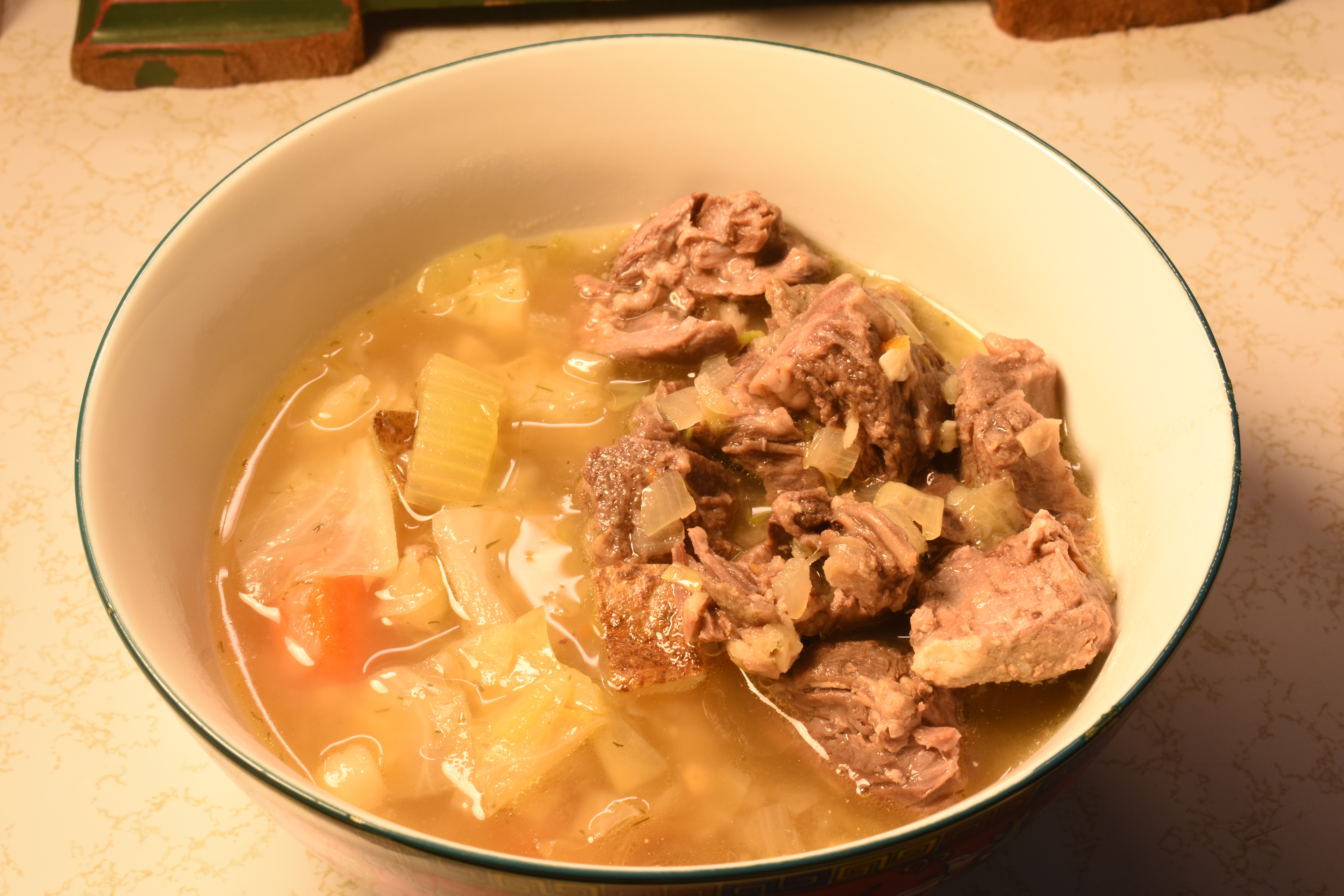
Shchi

This dish is pronounced “Shee”.  It is a Russian cabbage soup with a beef stock.  I have seen many recipes that call for a lot of distraction from its main shape.  For instance, some recipes want to add sour cream and other junk b/c they think that is the “Russian” way.  I don’t care about that.  It has two very important qualities that are universal across many beef stock dishes in many countries. 

The day before I cooked this dish a gave the beef a dry brine.  The night before I salted the meat with Kosher salt, covered in plastic and leave in the frig.  I put the beef in a crockpot early the next day with veggies and cooked it on high for 4 hours to get the meat tender and to give the beef stock a good beginning.  I used 2 large beef ribs and ½ pound of rib meat.  A stock needs a bone.  A broth is mostly with meat and veggies. 

Beef Stock

In crockpot add oil to the bottom and place on the bottom 1 whole carrot, 1 celery stalk, 2 cloves of whole garlic, a hand full of parsley, 1 TBSP of whole peppercorns and ½ onion skinned and whole.  Add the meat on top.  Add 1 cup of Chardonnay wine and three or four cups of chicken broth.   Add salt to taste.  Cook in the crockpot on high for about 4 hours.  Turn off the pot.  When the stock cools strain the stock and discard the veggies.  Remove the meat and cut into squares and set aside.  This process is used in may beef soups like Phở.  Phở is a Vietnamese soup dish.  Strain the stock and set aside.

Mirepoix for the Soup

Chop ½ onion, 1 carrot, 1 celery stalk, and 1 small leek (only the white part).  In a large Dutch oven, sauté the chopped veggies in olive oil.  Add ½ potato chopped into 1-inch pieces with the skin.  Add the strained beef stock, 2 garlic cloves and a bay leaf.  Bring the stock to a slight boil to cook until the potatoes are soft.  Add ½ small cabbage cut into 1-inch pieces.  Reduce the heat and cook for about 30 minutes until the cabbage is soft.  15 minutes before serving add a little dill.

Serving

On the bottom or side of the bowl add the beef previously cooked that was set aside, cover the meat with hot soup and serve. 

As of 2/2/22

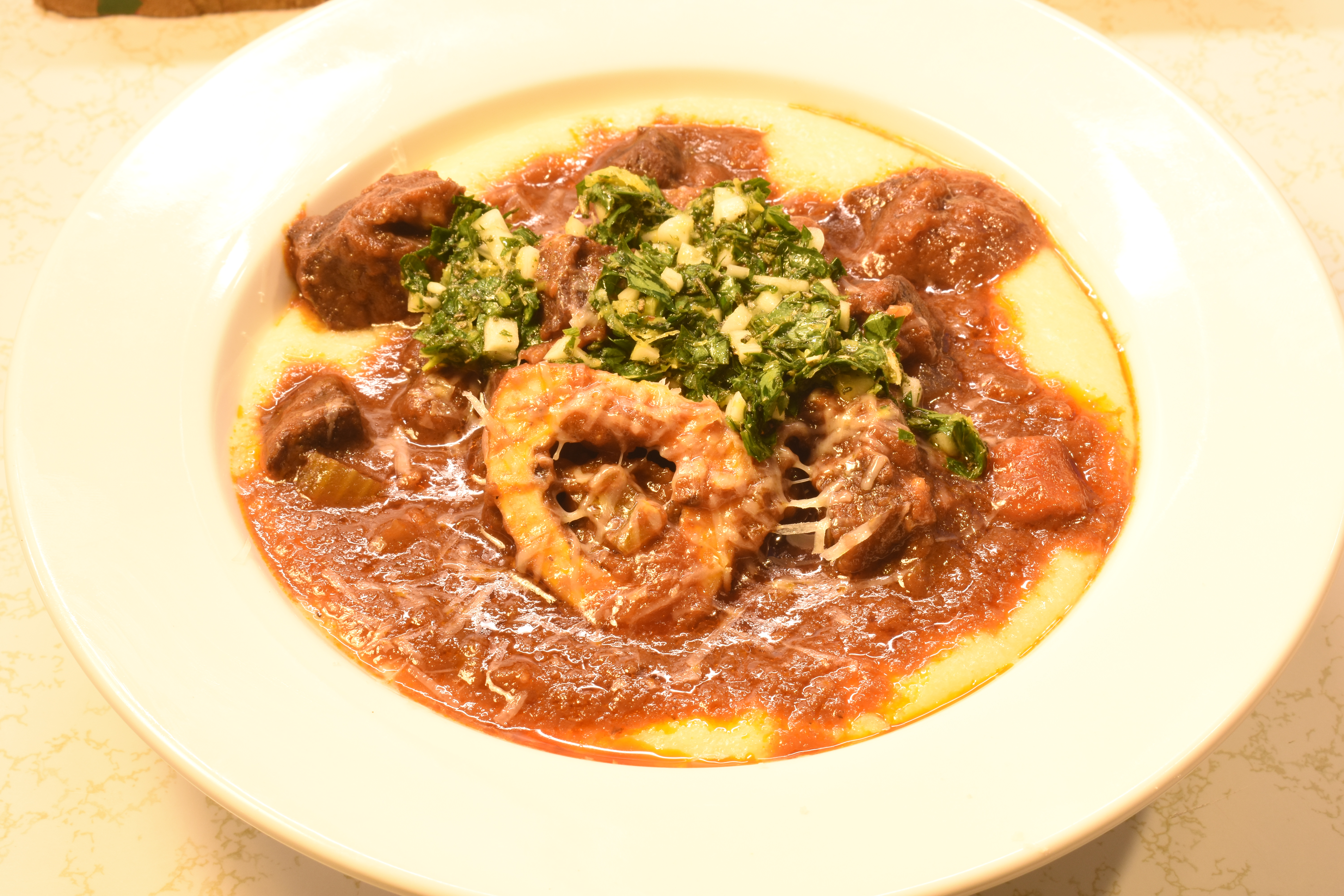
Osso Buco (Bone with a Hole)

DSC_0065(click on pics to enlarge)

(Osso = bone) + (Buco = hole)

This meat is a shank cut. The best part is the marrow in the center of the bone when cooked. Mostly, it is made with veal shank. However, veal shank can be expensive or impossible to find. Since the meat will cook for an hour and one-half or more, I substitute the veal with a beef shank. I can find beef shank for a third of the cost of veal and actually I think it has a place in this dish.

There are two types of Osso Buco.  The older versions from decades ago is made with veal and the sauce is a brown sauce.  It has virtually no tomatoes other than a little tomato paste and uses dry white wine.  It is considered the old-fashioned Milanese type.  Since I’m using beef shank, I prefer to use red wine, tomato paste and a tomato sauce.  The sauce I make each year from the San Marzano tomatoes I grow in my garden.  This version with tomatoes is a more modern adaptation.  One final deviation I do is after browning the shank I cut the meat away from the bone into bite size pieces.  However, I serve the bone with the dish.  It makes it more convenient to eat.  I serve both with polenta and gremolata.  So, this is really Osso Buco stew.

Serves 2

Ingredients:
2 beef shanks (or veal if available)
3 Tbsp. tomato paste
1 – 15 oz. can tomato sauce or puree. (I make my own each year from scratch and freeze)
½ cup of dry red wine (dry white will also work)
Polenta
Flour
EVOO
Salt and pepper
Meat broth as needed (I use veal stock when available but chicken broth works fine also.)
1 clove garlic (pressed)

Mirepoix:
2 carrots chopped into ½ inch pieces
1 half onion chopped
2 celery stalks cut into ½ inch pieces

Bouquet Garni:  Tie in a cheesecloth sack
1 sprig rosemary
2 sprigs oregano or thyme
1 bay leaf

Gremolata (Chopped herb garnish):
1 lemon grated for its lemon zest
1 clove garlic minced
2 Tbsp. Italian parsley finely chopped
¼ tsp. dried sage
1 Tbsp. fresh rosemary finely chopped
1 Tbsp. olive oil
1 tsp lemon juice
(Chop all the herbs and garlic.  Mix everything in a bowl.) 

DSC_0060

Cooking Directions:
Salt and pepper the meat and then dredge in flour. Brown in a Tbsp. or more EVOO in an oven proof pot. I use a 5 quart cast-iron pot with a lid.  Remove meat after browning and set aside.  The shank should be served whole with the bone in but I also find it better to cut it up in squares and serve the bone along with it.  It makes it easier to manage on the plate.

Add another Tbsp. EVOO and sauté the mirepoix.

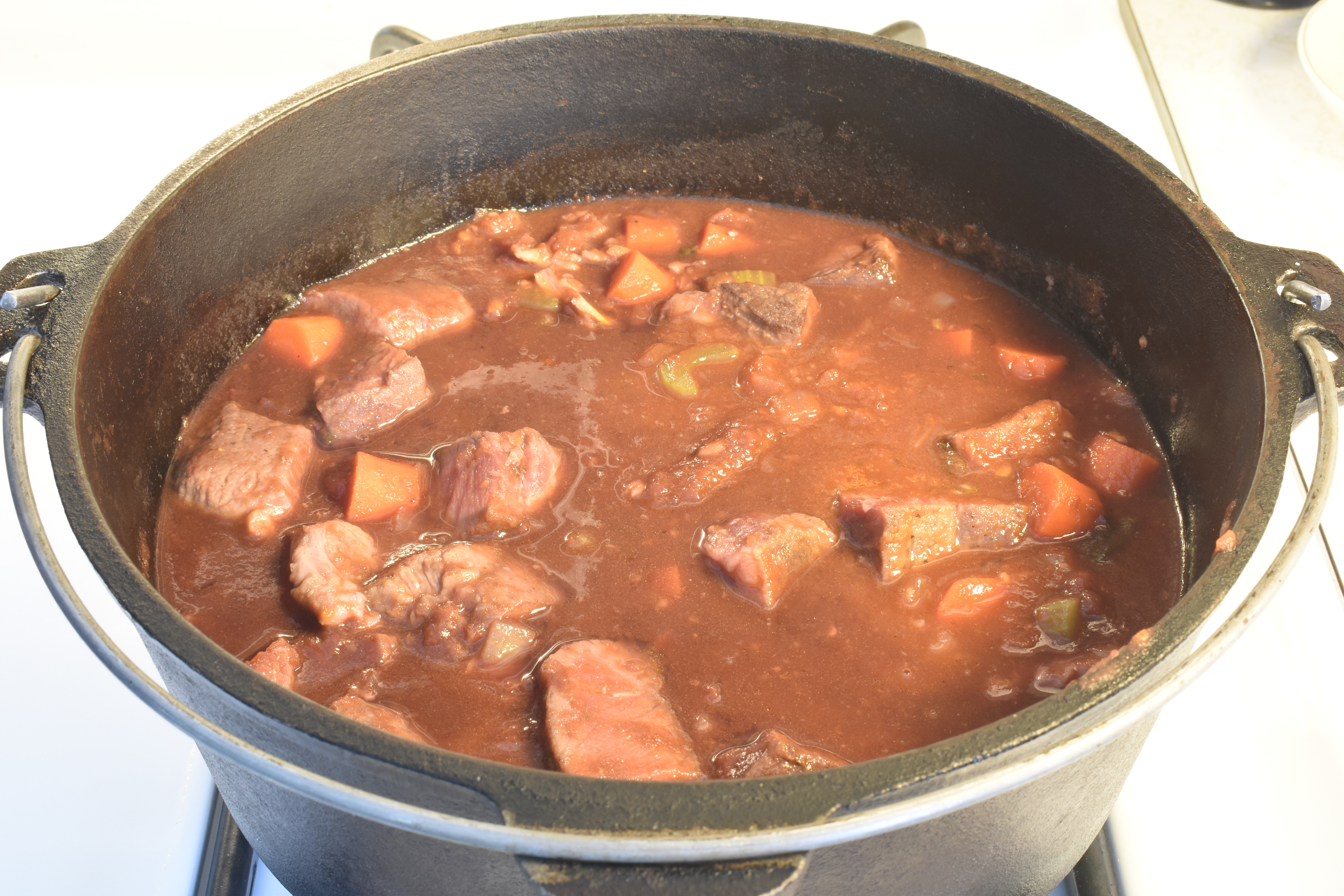
Mix the red wine and tomato paste in a cup or bowl until the paste has dissolved.  Add the wine mixture to the mirepoix and stir.  Add one cup of stock or broth and stir.  Salt and pepper to taste.  Bring to a light boil then reduce heat to simmer.  Add bouquet garni and simmer 20 minutes.

Return meat to the pot and then add pressed garlic. Add remaining stock or broth until the meat is covered. Then add a dash more of wine.

Place pot with a lid (Dutch oven) in a 350°F (180°C) oven for 1½ to 2 hours.  An alternative is to simmer on top of the stove for nearly 1½ to 2 hours or until the meat tender.

Serve on a bed of cooked Polenta or Risotto and garnish with Gremolata to serve.

600 calories for 8 oz. meat, 24g carbs.

As of 1/30/22

Zabaglione

Italian Desert Custard

6 egg yolks
1/3 cup sugar
¾ cup Madeira (or Marsala)
1 tsp grated lemon peel
Pinch cinnamon
Vanilla extract
1 cup whipped cream
Blue berries (any fruit)

Fill a sauce pot with water half way. Bring water to light boil and reduce heat to slightly under medium. Use a round bottom metal double boiler. Place over the pot of water and add all the ingredients except the blue berries (fruit) in the round double boiler and whisk on low heat until the mixture makes a custard. This might take a little while.  Be patient.  When it is the desired thickness, remove and place in a large bowl to cool. When cooled add a cup of whipped cream (Cool whip) and whip until it gets peaks. In something like a wine glass, add the fruit, then the Zabaglione, more fruit, then cool whip. Cover the glass with plastic wrap and cool in the frig until it’s time to eat. This dish is enough for four people. It is very rich. But, can be served in smaller quantity.  It has a very bold flavor.

“Main differences: Marsala is from the town Marsala in Sicily. Madeira is from the Madeiros Islands in the Atlantic. Madeira is made from Malvasia, Verdelho grapes.”

As of 12/31/21